

50 Years of Red River Revel
A History as Written…
…By Leone Reeder, co-chair (1976)
People didn’t understand the name, people didn’t understand the concept; in fact, Eleanor Colquitt and Sally Paschall were the only two people I know who had ever been to an arts festival! And so, it all began…
In early 1973 Shreveport was designated as one of the first Bicentennial Cities in the United States. Mayor Calhoun Allen named a twenty-member Regional Bicentennial Commission whose purpose was to coordinate and plan events for the year-long celebration in 1976. As a commission member, I was chairman of the Cultural and Arts Task Force. Knowing I needed HELP I quickly asked Bob Buseick, Eleanor Colquitt, Louis Collier, Cathey Graham, Delton Harrison, Ed Henderson, Sally Paschall, Gladys Lincoln, Jackie Nesbitt, Grove Ehlenst, Jacques Steinau, and Jean Sartor to serve on the Task Force. We were later joined by Virginia Shehee. Before our first meeting, Eleanor, in her usual cheerful fashion, said “Shreveport needs an arts festival.” My reply was, “a what?” As soon as Eleanor Colquitt met Sally Paschall it was clear we were on the road to an arts festival.
A festival-planning committee of the task force began meeting in the fall of 1973 and by the spring of 1974 had met with Ralph Burgard, an International Arts Consultant and established a time, a site, and a format for the event. It was to be a six-day festival held in October 1976; and all we needed was MONEY and VOLUNTEERS.
Armed only with our great idea and blissfully ignorant of the obstacles to come, we approached the Bicentennial Commission for money. In October of 1975 the Commission approved $15,000 for the festival. The next hurdle was to sell the idea to the Junior League, the only group we knew with the manpower, credibility, and funds to implement this ambitious undertaking. Reinforced with a slide presentation loaned by other festivals, Sally and I presented this brand-new concept to the League in November. We asked for a matching $15,000 co-sponsorship and a volunteer commitment. The League agreed; the festival project would be its bicentennial gift to the community. In December of 1974 Sally and I were asked by the League to be co-chairmen of the festival. We managed to assemble a “blue ribbon” group of dreamers, creators, and optimists as committee chairmen, league members and non-league members combined. Empty notebooks were no deterrent to Julia Blewer, Charlotte Walter, Dale Jeter, Peggy Lyons, Sandra Robertson, Virginia Chastain, Sylvia Goodman, Mimi Hussey, Julia Sippel, Eleanor Colquitt, Ann Merklein, Mary Margaret Weston, Susan Scott, Cathey Graham, Martha Shober, Tudy Crow, Nancy Lewis, Lloyd Diamond, Mary Lattier, Brenda Haley, Dot Hensley, Susu McCreight, Patti Lunn, Nancy Cosse, Sandy Kallenberg, Dixie Humphrey, Julia Galloway, Jean Sartor, and Maryanna Pringle.
Imaginations ran wild…we’d show movies on the outside back wall of the Convention Center, we’d refurbish railroad cars on the old tracks and have workshops in them, a sky diver would jump off the Texas Street Bridge to open the festival…and then practicality set in. A contest was held to name the festival and Sylvia Goodman’s entry “Red River Revel” was chosen. We had a name and soon, a logo.
Then we chartered a bus and went to Oklahoma City in May to see a real live arts festival. In June the Louisiana Bicentennial Commission granted us $7,750 and the Louisiana Council for Music and Performing Arts gave us $1,000. We had a grand total of $38,550 for our budget and thought we were rich!
September 1975 found Sally and me in Fargo, North Dakota studying their festival which included hundreds of school children in an extensive arts-in-education program. Bac home we cajoled Bill Wiener into designing our tents and artists booths after talking Gym Dandy in Bossier City into giving us leftover piping from their swing sets to make the tents with. Members of Links, a black volunteer group dedicated to arts and education were invited to join each committee. The Musician’s Union was asked to donate members’ time to perform. Celia Sawyer built “Captain Red”, our mascot, and wrote a song about him, and Nancy Humphrey smothered as she wore the costume around town.
Our forward-thinking committee set policies and goals: no private parties in connection with the festival; artist would be juried and pay the Revel a commission; there would be no admissions fee; every 4th, 5th, and 6th grader in Caddo-Bossier schools would come; the food would be provided by non-profit groups; all arts groups would work together, and more. The Revel could be enjoyed by the entire community, and we were determined to make it happen. In 1976 we got down to the “nuts and bolts” of building a mini-city of entertainment and educating the community. Bill Fountain, the director of the Bicentennial Commission, was invaluable in supervising all the city work crews, police, and firemen. He opened doors we didn’t know were there. It was exciting and fun, yet hard work often punctuated by the frustrations of inventing the wheel. People still said, “Red River what?”
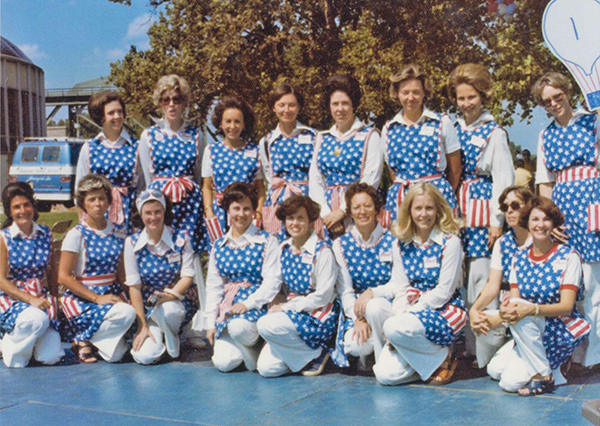
From Swepco to McDonald’s to Garden Clubs to Barksdale we begged for help all over North Louisiana…and the help came. Boy Scout troops painted our artist’s kiosks in a sweltering warehouse, Key Club members hammered and sawed, we painted our trash cans and stages and made ourselves wonderfully awful aprons of stars and stripes. Ann Marshall and Margaret Evans, League Presidents during these years, held our hands and encouraged us all.
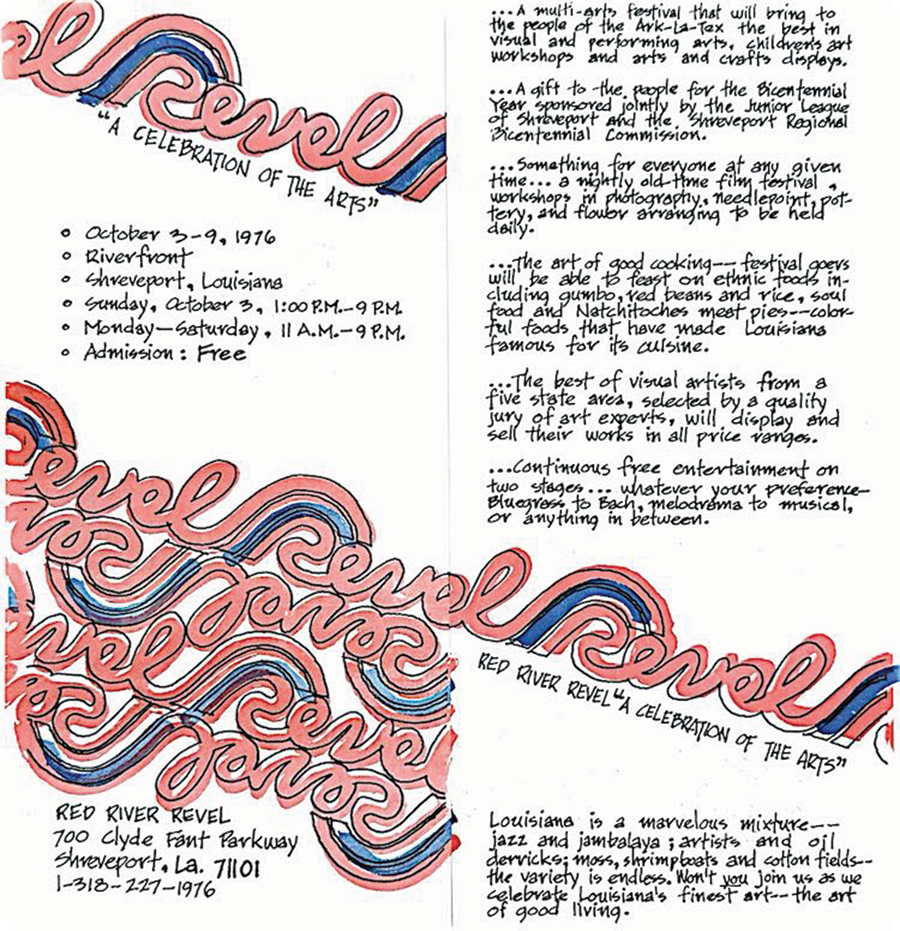
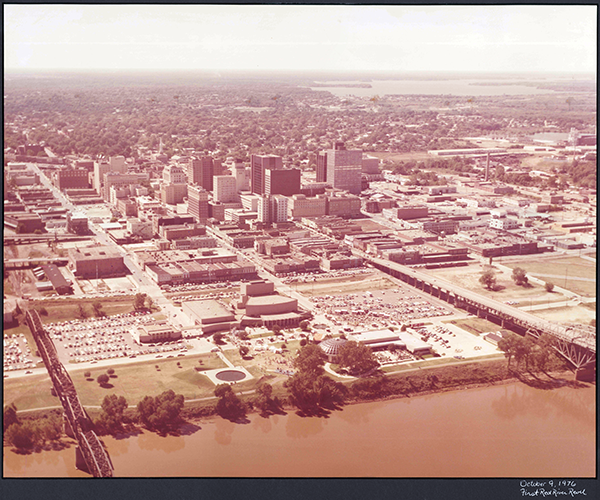
October 1976 finally arrived and with the help of over 1,000 husbands, children, and new best friends as volunteers, the Red River Revel became a reality! We were prepared, we thought for 50,000 people. By all estimates, 125,000 came…it rained for two days, the “romantic” Coleman lanterns that lit the tents had to be refilled every three hours, the children’s tents blew down, and we ran out of Cokes, ice, and Natchitoches meat pies. But then, we noticed the artists’ works were selling, the bands were playing, the food was great, and the people were coming and staying and smiling. The Revel was a hit and we were ecstatic.
Like Eleanor Colquitt, who had ordered 10,000 chrysanthemums to sell (and kept selling them from Weingarten’s parking lot after the festival was over), our unsung heroes were the committee members and volunteers who gave untold and unexpected hours without complaint. All of this was done with the knowledge that this was to be one-time-only event, but we kept our fingers crossed that the League would want to do it again. We had, after all, made $4,000 profit to be used for another festival.
The next January, the League and the city approved another Revel and invited Louisiana Bank and Trust to join them to give the Revel that rare and effective combination of sponsorship, city government, the volunteer sector, and private business.
Although Sally is in New Mexico now and I’m in Houston no, each October our hearts are in Shreveport. For all of us on the first committee, the Red River Revel is a sentimental event. It represents a “dream come true.” We had the opportunity to give something good back to the community we love by adding to the quality of life of great numbers of people and we did it. The Revel has come a long way from its humble beginnings as a naïve dream. And yet it still captures that spark of imagination and dreamer in all of us. With the passing of every year, new enthusiasm, new ideas, and new visions keep the Revel as young and exciting as it was to handful of bright-eyed optimists in 1973. After all…why dream small?